
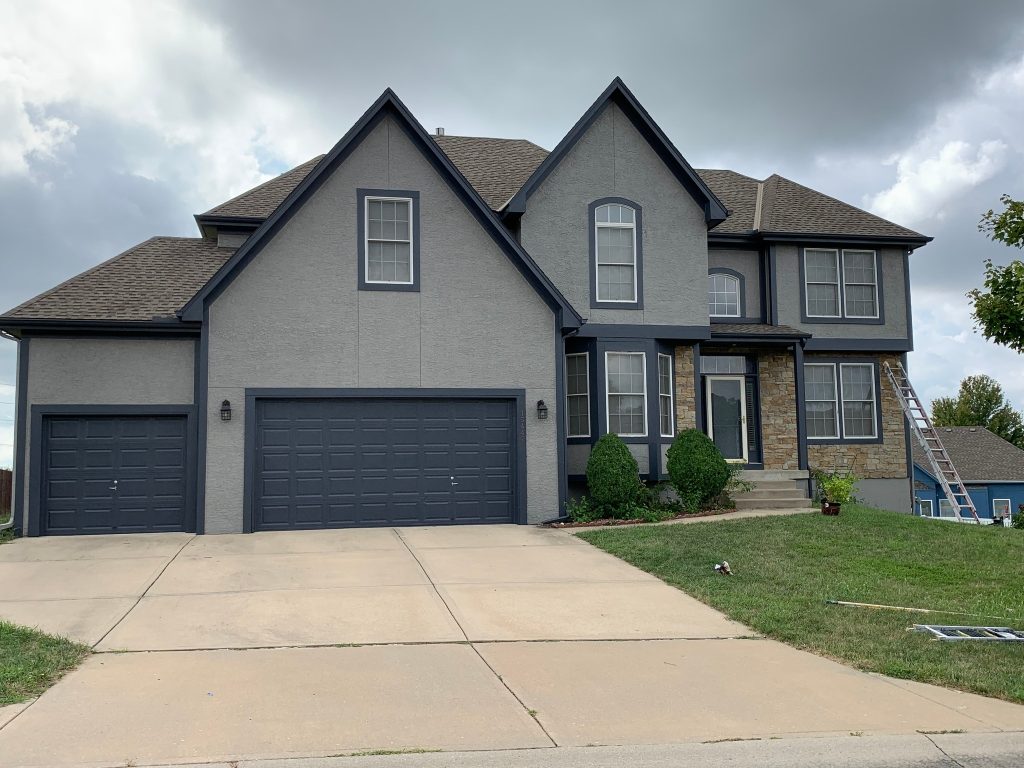
Kansas is hard on houses in ways that homeowners who’ve never lived somewhere else rarely appreciate, because the damage happens so gradually that it just looks like normal aging. Paint that’s rated to last ten to fifteen years in moderate climates routinely shows visible failure in six to eight years on Kansas City-area homes, and the assumption is usually that the product was subpar or the painter cut corners. Sometimes that’s the case. But far more often, the accelerated failure is a direct consequence of the specific combination of environmental stressors that Kansas delivers to exterior paint films year after year — not any single extreme, but the relentless interaction of intense UV radiation, sustained summer heat, dramatic temperature cycling, and the freeze-thaw punishment that no coastal or southern climate comes close to matching. Each of these forces attacks the paint film through a different degradation mechanism, and understanding how they work individually and compound collectively explains why exterior paint in our region lives a harder, shorter life than the same product applied to a home two states in any direction.
The UV Problem: Kansas Skies Are Clearer Than You Think
When homeowners think about UV damage to paint, they tend to associate it with desert climates or tropical latitudes where sunshine is constant and intense. Kansas doesn’t fit that mental image, but the data tells a different story. The Kansas City metro area receives an average of roughly two hundred fifteen sunny or partly sunny days per year, and the flat, open topography of the region means there’s very little terrain shading or atmospheric moisture filtration reducing UV intensity compared to coastal or mountainous areas. During the long days of June and July, Kansas City receives UV index readings that routinely reach eight to ten on clear days — levels classified as “very high” by the EPA and comparable to readings in parts of the American Southwest during the same months.
UV radiation attacks exterior paint through a process called photodegradation, and its mechanism is specific and cumulative. The high-energy photons in ultraviolet light penetrate the surface of the paint film and break molecular bonds within the acrylic resin that forms the structural backbone of the coating. Each broken bond represents a tiny fracture in the polymer chain, and while no single bond breakage is significant, the accumulated effect of millions of bond ruptures over multiple summers progressively dismantles the resin matrix that holds the paint film together. The outward symptom of this process is chalking — the powdery residue you can wipe off the surface of weathered paint with your hand. That powder is the pigment particles that were once locked within the resin matrix, now sitting loose on the surface because the resin around them has been destroyed by UV exposure. Chalking isn’t dirt or dust accumulation. It’s the physical evidence that the structural integrity of the paint film is being consumed from the outside in.
South-facing and west-facing walls on Kansas City-area homes receive the most intense UV loading and chalk fastest. On many homes, you can see a dramatic difference in paint condition between the north elevation, which may still look acceptable after eight years, and the south or west elevation, which shows heavy chalking, fading, and early adhesion loss after just five or six years. The same paint was applied to both elevations on the same day by the same crew. The difference is entirely attributable to cumulative UV dosage, and it means that different sides of your home are aging at different rates — a factor that matters when planning repaints and evaluating whether a full-house project is necessary or whether targeted elevation work can extend the overall system life.
Sustained Heat: The Slow Cooker Effect on Resin Chemistry
UV radiation breaks the paint film apart from the outside, but Kansas summers attack it from within through a subtler mechanism called thermal degradation. When exterior surface temperatures on siding climb above one hundred twenty degrees — which happens routinely on dark-colored or sun-exposed surfaces during July and August in the Kansas City area — the acrylic resin in the paint film enters a state of accelerated molecular mobility. At elevated temperatures, the polymer chains that form the film structure become more energetic and begin undergoing chemical reactions with oxygen in the air, a process called thermo-oxidative degradation.
This process doesn’t melt or visibly damage the paint. Instead, it gradually changes the chemistry of the resin in ways that make the film progressively harder and more brittle. Fresh acrylic paint has a carefully engineered balance of hardness and flexibility — hard enough to resist physical damage and cleaning abrasion, flexible enough to expand and contract with the substrate as temperatures change. Thermo-oxidative degradation shifts this balance toward brittleness by cross-linking the polymer chains into a tighter, more rigid network than the original formulation intended. The result is a paint film that slowly loses its ability to flex without cracking. This embrittlement process is invisible and progressive, and its consequences don’t appear until the film is stressed by the temperature swings that Kansas delivers with particular brutality.
What makes this mechanism especially insidious is that it’s most aggressive during the same summer months when the film appears to be performing well. The paint looks great in July. The surface is hard, the color is holding, and no visible defects are present. But the resin chemistry is shifting beneath the surface, quietly converting a flexible, resilient film into a rigid one that’s primed for failure the moment conditions change. The damage done during summer reveals itself during the temperature drops of fall and winter, when the newly embrittled film is asked to contract with a substrate that’s cooling rapidly — and can no longer comply without cracking.
Temperature Cycling: The Mechanism That Turns Invisible Damage Into Visible Failure
Kansas City sits at the intersection of continental and subtropical air masses, creating one of the most dramatic temperature cycling environments in the continental United States. The region regularly experiences temperature swings of thirty to forty degrees within a single twenty-four-hour period during spring and fall, and the annual temperature range from summer highs to winter lows spans well over one hundred degrees. Every material in your home’s exterior assembly — wood framing, sheathing, siding, trim, and the paint film covering all of it — expands when heated and contracts when cooled. The critical issue is that each material expands and contracts at a different rate, and the paint film sitting on the outermost surface must accommodate the movement of the substrate beneath it while maintaining its own structural integrity.
A healthy, properly cured exterior paint film has enough elasticity to handle this differential movement without damage. But a film that has been embrittled by thermo-oxidative degradation during the summer has lost a significant portion of that elasticity. When a sharp temperature drop occurs — a cold front sweeping through the metro in October that drops temperatures from seventy-five degrees in the afternoon to thirty-five degrees overnight — the siding contracts faster than the rigid paint film above it can accommodate. The film doesn’t stretch. It cracks. These initial cracks are often hairline fractures invisible from ground level, but they represent fundamental breaches in the paint film’s continuous barrier. Once the barrier is broken, moisture, additional UV radiation, and oxygen gain direct access to the substrate through every crack, accelerating the degradation on both sides of the film and dramatically shortening the remaining functional life of the coating.
The Kansas City area’s spring and fall transition seasons are when most of this cracking damage accumulates, because these are the months with the most frequent and dramatic temperature swings. A single week in April or October can include multiple thirty-degree overnight drops, each one stressing the embrittled film and propagating existing cracks while initiating new ones. By the time a homeowner notices visible cracking or peeling, the paint system has typically been accumulating micro-fractures for one to two full seasonal transition cycles.
Freeze-Thaw: The Final Assault
Winter in the Kansas City area delivers the coup de grâce to paint films that have already been weakened by UV degradation, thermal embrittlement, and temperature cycling cracks. The freeze-thaw mechanism is devastatingly simple: moisture that has infiltrated through micro-cracks in the paint film freezes when temperatures drop below thirty-two degrees. Water expands approximately nine percent in volume when it freezes, and this expansion generates enormous mechanical force within the narrow space between the paint film and the substrate. Each freeze event wedges the film slightly farther from the surface. Each thaw event allows additional moisture to seep into the expanded gap. The next freeze pushes the film farther still.
Kansas City averages roughly one hundred freeze-thaw cycles per winter — days where the temperature crosses the thirty-two-degree threshold in both directions within a twenty-four-hour period. That number is significantly higher than cities at the same latitude but closer to moderating ocean influence, and it’s the primary reason exterior paint in our region fails faster than national averages suggest. One hundred freeze-thaw cycles per winter means one hundred rounds of mechanical wedging at every micro-crack and adhesion weakness in the paint system. After two or three winters, cracks that started as invisible hairlines have propagated into visible fissures, adhesion has been mechanically broken across widening areas, and the paint begins actively peeling and flaking.
The freeze-thaw mechanism also explains why paint failure in Kansas is so often concentrated at specific locations on the house rather than appearing uniformly. Horizontal trim surfaces, window sills, the bottom edges of siding boards, and any joint where caulking has cracked or separated collect and hold moisture more readily than flat vertical surfaces. These moisture-concentrating locations experience more intense freeze-thaw damage because more water is present at each cycle. A window sill that traps a small pool of water behind cracked caulking may go through the same one hundred freeze-thaw cycles as the surrounding siding, but the force generated at the sill is orders of magnitude greater because there’s far more water present to expand.
Why the Damage Compounds Rather Than Accumulates Linearly
The critical insight about exterior paint failure in Kansas is that these four mechanisms — UV photodegradation, thermal embrittlement, temperature cycling cracks, and freeze-thaw wedging — don’t simply add together. They compound each other in a cascading feedback loop that accelerates failure exponentially once it begins. UV radiation weakens the resin structure. Weakened resin embrittles faster under summer heat than healthy resin would. Embrittled film cracks sooner and more extensively during temperature swings. Cracks admit moisture that fuels freeze-thaw damage. Freeze-thaw damage exposes fresh resin surface to UV radiation, and the cycle accelerates.
This compounding effect is why exterior paint failure in Kansas often appears to happen suddenly after years of looking fine. The paint isn’t failing suddenly. It’s been degrading progressively along all four pathways simultaneously, with each pathway feeding into and amplifying the others. There’s a tipping point where the accumulated damage reaches a critical threshold and the visible symptoms — chalking, cracking, peeling, flaking — seem to appear all at once. By the time a Kansas City homeowner notices the problem, the paint system is typically well past the point of viable repair and full recoating is the only effective solution.
What This Means for Product Selection and Maintenance Timing
Understanding these degradation mechanisms has practical implications for how Kansas City homeowners should approach exterior painting. Premium exterior paints formulated with UV-stabilized resins and high-flexibility acrylic binders resist all four mechanisms more effectively than budget products because they start with a stronger resin matrix, more robust UV inhibitors, and greater built-in elasticity to absorb temperature cycling without cracking. The additional cost per gallon translates directly into additional years of service life, and in a climate as demanding as ours, that math heavily favors the premium product.
Maintenance timing also matters more in Kansas than in milder regions. Waiting until paint is visibly failing before scheduling a repaint means the cascading degradation cycle has already progressed to an advanced stage, often involving substrate damage that increases the scope and cost of the next paint job. Proactive repainting on a six-to-eight-year cycle, before the compounding effect reaches its tipping point, keeps each new coat bonding to a sound substrate and prevents the exponential damage phase from ever fully developing.
Let Stone Painting Protect Your Home Against What Kansas Throws at It
The Kansas City climate doesn’t give exterior paint the benefit of the doubt, and it doesn’t reward homeowners who treat paint maintenance as something they’ll get to when the peeling becomes impossible to ignore. Stone Painting understands the specific degradation cascade that our climate drives — the UV exposure that starts the process, the summer heat that embrittles the film, the temperature swings that crack it open, and the freeze-thaw cycles that finish the job — and we build every exterior project around products and preparation methods engineered to resist this entire sequence, not just one piece of it. If your home’s exterior is showing the early signs of paint system failure or if you’re approaching the proactive maintenance window where the smartest money is spent, contact Stone Painting today to schedule your free estimate. We’ll assess every elevation, identify where the degradation cycle stands on each surface, and put together a plan that gives your home the maximum possible protection against everything Kansas has in store.