
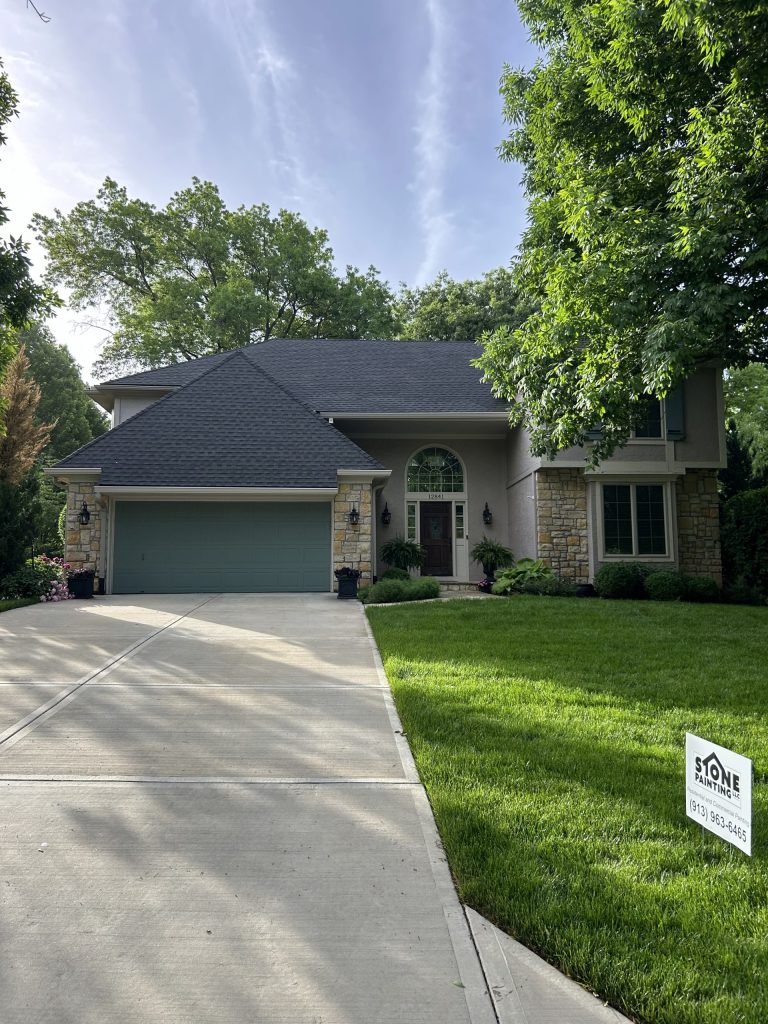
The coat count question comes up in almost every estimate conversation, and the answer a homeowner gets often depends more on who they’re talking to than on what the house actually needs. Some contractors quote two coats on everything as a blanket standard because it simplifies their pricing and eliminates judgment calls. Others quote one coat across the board to keep the bid low and win the job on price. Neither approach serves the homeowner well because neither one is based on what’s actually happening on the surfaces of that specific house. The honest answer — the one that saves you money where coats aren’t needed and protects your investment where they are — requires evaluating the current condition of every surface, understanding what each coat of paint physically accomplishes at the film level, and recognizing that different areas of the same house can have legitimately different coat requirements based on their orientation, substrate condition, and exposure history. A blanket coat count applied uniformly to an entire Kansas City-area home ignores the reality that your south-facing siding has lived a completely different life than your north-facing siding, and treating them identically either wastes money on one elevation or under-protects the other.
What Each Coat Is Actually Doing to Your Exterior
Every coat of exterior paint serves a dual purpose that goes beyond simply adding color to the surface. The first purpose is opacity — providing enough pigment density to fully hide whatever color, stain, or surface condition exists beneath it. The second purpose is film build — depositing enough resin material to create a continuous, weather-resistant barrier of adequate thickness to withstand the UV radiation, moisture cycling, and temperature extremes that Kansas City delivers to every exterior surface.
These two purposes don’t always align on the same coat count. A single coat of premium exterior paint applied at the manufacturer’s recommended spread rate deposits a dried film thickness of approximately one and a half to two mils. That single coat may achieve full opacity over a similar existing color, meaning the house looks completely finished and the color is accurate. But that single coat provides only half the total film build that the product’s durability ratings are engineered around. When a manufacturer states that their exterior paint will last ten to twelve years, that claim assumes a two-coat film system with a total dried thickness of three to four mils. A single coat may look identical on day one, but its thinner barrier will degrade faster under UV exposure, crack sooner under temperature cycling stress, and admit moisture more readily through its reduced film density. In the Kansas City climate, where UV intensity, thermal swings, and freeze-thaw cycles are all above national averages, the performance difference between a one-coat and two-coat film system isn’t marginal. It can mean the difference between eight years of service life and four.
This is the fundamental tension in the coat count conversation. Appearance and protection are not the same thing, and a surface that looks fully covered after one coat is not necessarily fully protected. The coat that makes the house look finished and the coat that makes the finish last are sometimes the same coat, but often they aren’t.
When One Coat Is Legitimately Sufficient
Despite the general superiority of two-coat systems, there are specific exterior scenarios where a single coat provides both adequate opacity and adequate film build, and applying a second coat in these situations adds cost without adding meaningful performance. The most common one-coat scenario on Kansas City homes is a maintenance repaint where the existing paint is in sound condition and the new color is the same or very similar to the existing color.
When the existing coating is well-adhered, not heavily chalked, and has been properly cleaned and prepared, it serves as a stable, sealed substrate that doesn’t absorb the new paint unevenly or demand heavy pigment loading to achieve hide. A single coat of premium exterior paint over this sound, color-matched base achieves full opacity because the underlying color isn’t fighting against it, and it achieves adequate total film build because the existing paint beneath it is still contributing its own intact barrier. The combined system — old coating plus new single coat — delivers total film thickness comparable to a fresh two-coat application over bare substrate. The key qualifiers are that the existing paint must be genuinely sound, meaning no peeling, no heavy chalking, and no adhesion concerns after pressure washing, and the color change must be minimal.
Protected surfaces that receive limited weather exposure can also be legitimate one-coat candidates. Deep porch ceilings, sheltered soffits, and covered entryway walls on Kansas City homes receive a fraction of the UV, rain, and temperature stress that exposed siding endures. These surfaces degrade much more slowly, and their existing coatings typically retain more of their original film integrity at the time of repainting. A single fresh coat over a sound existing finish on a protected surface can deliver excellent longevity because the environmental demands on that surface are dramatically lower than what exposed walls face.
Why Two Coats Is the Professional Standard for Most Exterior Work
For the majority of exterior painting projects in the Kansas City area, two coats is the correct specification, and the reasons extend beyond simple coverage. Most real-world exterior repaints involve at least a moderate color change, surfaces with varying degrees of weathering and repair, and elevations that have lost significant film thickness to UV degradation and chalking since the last paint job. Even when the homeowner is staying with the same general color family, the existing weathered surface is rarely uniform enough in color and condition to achieve a flawless result with a single coat.
Two coats over a properly prepared exterior accomplish several things that a single coat cannot. The first coat fills micro-texture in the surface, seals any residual porosity from chalking or weathering, and establishes a uniform color base that eliminates the patchwork appearance created by repaired areas, replaced boards, and differential weathering across the elevation. The second coat provides the finished color accuracy, uniform sheen, and critical additional film thickness that determines long-term durability. Without that second coat, repaired areas and replaced siding boards often remain faintly visible as slight color or sheen differences — variations that are invisible the day the paint is applied but emerge over the following months as the single coat weathers and thins unevenly over substrates of different porosity.
The film build argument for two coats is especially compelling in the Kansas City climate. As covered in depth elsewhere, our region’s UV intensity, thermo-oxidative stress, temperature cycling, and freeze-thaw assault consume exterior paint film faster than moderate climates. A two-coat system with three to four mils of total dried film provides roughly twice the sacrificial material for UV photodegradation to consume before it reaches the resin structure that holds the film to the substrate. In practical terms, this means the two-coat system doesn’t just last twice as long as a one-coat system — it lasts disproportionately longer because the degradation mechanisms are consuming surface material while the underlying film remains intact and functional. By the time UV exposure has chalked away the outermost mil of a two-coat system, the remaining two to three mils still constitute a sound, continuous barrier. The same UV exposure on a one-coat system consumes a proportionally larger percentage of the total film, reaching the adhesion-critical zone much sooner.
The Situations That Demand Three Coats
Three-coat exterior applications are less common but absolutely necessary in specific scenarios that Kansas City painters encounter regularly. The most frequent is painting over bare wood substrate, whether from new construction, full scrape-and-repaint projects, or replacement of damaged siding and trim boards. Bare wood requires a dedicated primer coat that serves a fundamentally different function than the topcoats above it. The primer penetrates into the wood grain, seals its porous structure, locks in tannins and extractive compounds that would otherwise bleed through the finish, and creates a stable bonding surface for the topcoat system. This primer coat plus two topcoats equals three total coats on every bare wood surface. Attempting to reduce this to primer plus one topcoat on bare exterior wood in the Kansas City climate is a false economy that reliably produces premature failure because the single topcoat doesn’t provide enough film build to withstand our environmental demands over the bare wood substrate’s aggressive porosity.
Dramatic color changes on exterior surfaces also require a three-coat approach. Moving from a dark body color to a significantly lighter one, or shifting across color families entirely, demands a tinted primer to neutralize the existing color before two topcoats can achieve accurate color development. Two topcoats alone over a dramatically different base color will produce a finish that appears slightly off — muddied, uneven, or subtly influenced by the old color bleeding through — particularly as the new paint weathers and thins over time. The tinted primer establishes a neutral canvas that allows both topcoats to work toward color accuracy rather than spending their pigment density fighting against the old color beneath them.
Severely weathered surfaces that have lost significant film build and substrate integrity through years of Kansas exposure may also warrant a three-coat system. When existing paint has been heavily chalked by UV degradation, the remaining film is thin, porous, and potentially compromised in its adhesion to the substrate. A penetrating bonding primer re-establishes substrate integrity and adhesion in these deteriorated zones, and two topcoats rebuild the total film thickness to a level that can withstand another full service cycle. Skipping the primer on a severely degraded surface and applying two topcoats instead puts fresh paint over a weak foundation, and the Kansas City climate will find and exploit that weakness within a few seasonal cycles.
Why Different Elevations on the Same House Can Need Different Coat Counts
This is the nuance that blanket coat-count specifications miss entirely, and it’s one of the most important factors in getting honest value from an exterior painting project. On a typical Kansas City home, the south and west-facing elevations receive dramatically more UV radiation, heat loading, and weather exposure than the north and east-facing elevations. After six to eight years, the south-facing siding may be heavily chalked, faded, and showing early adhesion loss, while the north-facing siding still looks and feels sound with good color retention and intact film adhesion.
An honest assessment of this house might specify two coats on the south and west elevations where the existing film is degraded and needs full rebuilding, and a single coat on the north and east elevations where the existing coating is still contributing meaningful protection. This elevation-specific approach provides appropriate protection where it’s needed and avoids unnecessary cost where it isn’t. It also acknowledges the reality that the next paint cycle will likely follow the same pattern — the sun-hammered elevations will need attention sooner than the sheltered ones, and a homeowner who understands this can plan maintenance strategically rather than defaulting to a full-house repaint every cycle regardless of condition.
Trim and siding also warrant separate evaluation. Horizontal trim surfaces — window sills, water tables, fascia boards, and the top edges of rake trim — take far more weathering punishment than vertical siding because they collect moisture, receive direct UV from above, and experience temperature extremes more intensely. These surfaces often need a full primer-plus-two-topcoat system even when the adjacent vertical siding is in sound enough condition for a single maintenance coat. Quoting the entire house at the same coat count ignores this surface-specific reality and either over-specifies the siding or under-specifies the trim.
How Product Quality Changes the Coat Count Math
The coat count conversation cannot be separated from the product quality conversation because the two are directly linked. Premium exterior paints are formulated with higher pigment volume concentrations for superior one-coat hiding, denser resin systems that deposit more barrier material per coat, and advanced UV stabilizers that extend the functional life of each mil of film. A premium product achieving ninety-five percent opacity and two mils of dried film in one coat delivers fundamentally different performance than a builder-grade product achieving seventy percent opacity and one and a half mils per coat.
This means the same house evaluated for the same project might need two coats of a premium product or three coats of a budget product to reach the same level of opacity and film build. When labor cost, which is the largest component of any professional painting project, is factored in, the additional labor for a third coat of cheap paint almost always exceeds the additional material cost of two coats of premium paint. Homeowners evaluating quotes should always ask what product is being specified and how many coats are included, because a lower bid using budget paint with an extra coat may cost more in total while delivering an inferior result compared to a higher bid using premium paint in fewer coats.
Let Stone Painting Give You an Honest Coat Count Based on What Your Home Actually Needs
The right number of coats for your home isn’t a guess, a habit, or a sales strategy — it’s a surface-by-surface assessment based on what each elevation, each substrate, and each trim detail genuinely requires to achieve both full coverage and full protection against the Kansas City climate. Stone Painting evaluates every project with this precision, specifying primer where substrate conditions demand it, two topcoats where film build and color change require them, and honest single-coat recommendations where the existing surface is sound enough to deliver a durable result without unnecessary product and labor. We don’t pad coat counts to inflate bids, and we don’t cut them to win on price. We specify what each surface needs and explain why. Contact the team at Stone Painting to schedule your free estimate and get a coat count recommendation built on what your home’s surfaces are actually telling us, not on a one-size-fits-all formula.